
Searching Polk County Criminal Dockets
Begin with the cause number and the court named on it. The re:SearchTX court-record search covers the Polk County criminal dockets it reaches. You can pull case, filing, text, and hearing details there. An account is required. Access depends on your role. Coverage is not complete for every local record. Jot down the court, the initial filing date, the charge category, and the latest event.
No match? Go straight to the clerk who holds the record. The District Clerk keeps district felony files. The County Clerk holds County Court and County Court at Law criminal records. Class C matters belong to the Justice Court or the city clerk involved.
- Copy the cause number, full name, approximate year, and court.
- Search re:SearchTX Cases, Filings, and Hearings.
- Match court, caption, dates, and charge category.
- Read events from charging paper through judgment.
- Ask the proper clerk for unavailable or certified documents.
Polk Criminal Docket Routes
A Polk County criminal court docket lives in different places. It depends on jurisdiction. Felony cases land mostly in the 258th and 411th Judicial District Courts. Class A and Class B misdemeanors go to County Court at Law. Class C cases are split among four Justice Courts and city Municipal Courts. Each sits within its own authority.
| Matter | Court | Custodian |
|---|---|---|
| Felony | 258th or 411th District | District Clerk |
| Class A/B misdemeanor | County Court at Law | County Clerk |
| Class C or ordinance | Justice or Municipal | Local clerk |
A city ticket will not show up in a district felony search. Often the court name matters more than a broad query on a person's name.
Inside a Polk Criminal Docket
Think of a Polk County criminal docket as a timeline, not the whole file. One line may list the court, cause number, charge, attorney, bond or magistration events, settings, motions, plea, trial activity, judgment, sentence, costs, and the latest filing date. A restricted or missing image can hide paperwork while the event line stays.
| Cause number | The exact court identifier, shown as a Polk cause number; do not guess its format. |
|---|---|
| Charge | The alleged offense and statute, not proof of guilt. |
| Setting | Arraignment, pretrial, plea, jury week, bench trial, or another event. |
| Disposition | An outcome to check against the signed judgment. |
| Access marker | A clue that an image is sealed, redacted, fee-based, or role-limited. |
"Filed" does not mean granted, and "set" does not mean heard. A complaint or indictment only states an allegation. The judgment is what supplies the formal result.
Polk Cost Portal Limits
The county court-cost portal takes a cause number. It also accepts name and birth date, business name, license, vehicle, or other account fields. It works well for tracking a known account. It is no substitute for the full criminal docket.
A balance tells you nothing about the allegation. It says nothing about the case history, the judgment, or any later order. Be careful with sensitive data. Does the portal find an account but no document? Carry the cause number and court name to the proper clerk.
Key point: A payment-account hit is a lead, not a certified Polk County criminal disposition.
How a Criminal Case Moves
A felony often opens with complaint and arrest events. It then moves through magistration and bond to indictment and arraignment. From there the docket shows discovery, motions, settings, plea or trial, and judgment. Misdemeanor and Class C cases tend to run a shorter route. Their charging paper differs too.
Docket flow: Filing › Arraignment › Pretrial › Plea or Trial › Disposition › Sentencing
A continuance only moves a setting. It never dismisses the charge. A plea can come before judgment, and community-supervision terms come from the signed order, so read amended charges and separate counts alongside the latest entry.
Polk Criminal Docket Terms
Short labels hide major differences. These terms separate accusation, request, setting, and result.
- Magistration
- An initial process that may address warnings, probable cause, and bond.
- Indictment
- A grand-jury charging instrument, not a conviction.
- Motion
- A request for a ruling; a later order shows the result.
- Pretrial
- A hearing before trial that may produce another setting.
- Sentence
- Punishment terms recorded with the judgment.
Criminal standing orders and calendars are posted by the 258th District Court. Those materials explain local practice, though the filed order still controls each case.
Courts That Hold Criminal Dockets
For 258th and 411th District Court records, the District Clerk is the local route. The County Clerk criminal form covers what sits in that office, from information and complaint to judgment and dismissal requests. Regular copies, certified copies, clerk searches, and current online queries are separate products. Ask for the one you need.
Requests go faster with the cause number and court. Add the full name, approximate year, and the exact document. District records are served at Suite 216, 101 W Mill Street, Livingston, and 936-327-6814. County records sit at Suite 265. The office publishes a criminal request form that supports mail or phone/card delivery. Class C records stay with each local court.
Federal cases run through Eastern District of Texas systems and PACER. They do not use Polk County docket channels. Confirm the court heading first, always.
Polk Criminal Calendar Signals
Labels on the combined calendar include 258, 411, CCL Misdemeanor, TRIAL WEEK, POLK, and TRINITY. They mark blocks and assignments, nothing more. A trial week proves nothing about a verdict.
Read court, county, event, date, and time together. A 258th setting request counts only after its coordinator confirms it. Check every calendar signal twice. Use the latest notice plus the clerk or coordinator. The Polk County court dates page lays out the full calendar path.
Sealed Dockets and Public Access
Juvenile information is protected under Texas Family Code Chapter 58. Expunction follows Criminal Procedure Chapter 55A. Sealed filings, protected addresses, and redacted data can stay hidden as well.
Access rules: Government Code section 552.0035 recognizes special rules for judicial information. The Texas Judicial Branch Rule 12 policy explains judicial-record access.
Do not bypass a restriction. Ask the custodian which lawful process applies.
A blank result does not prove a case never existed. Coverage, timing, custody, sealing, expunction, and role limits all shape what displays. For the formal outcome, rely on a signed judgment or certified copy.
Polk Criminal Request Form
The official County Clerk criminal form shows the fields used to narrow a request.
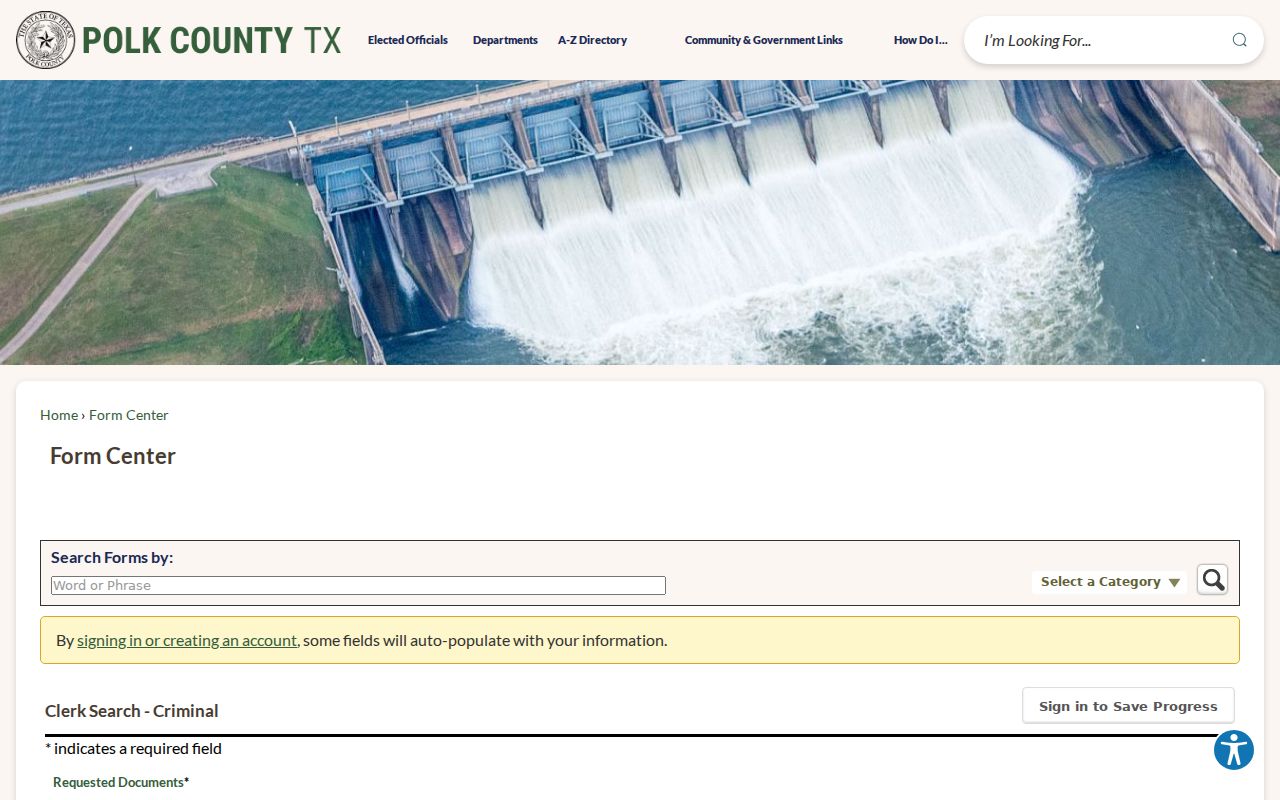
This is why record type, name, copy choice, delivery route, and clear comments all matter on the form. Even a submitted form does not replace current docket confirmation.
The County Clerk's request form asks you to pick what kind of entry you want. A complaint is one thing. A judgment or dismissal is another. Choosing wrong can cost you a copy of the wrong paper, because a charging step is only the start of a case, not its outcome. Write the court and the year in the comments box. That small detail lets staff pull the right file series and separate your case from others filed under a similar name.
Fees are listed right on the form. The clerk charges $5 for a search. Regular copies run $1 per page. Certified copies cost $5 plus $1 per page. The office may take up to ten days to finish a request. Call ahead to confirm current prices and timing before you order anything.
Older district records travel a different road. Polk County's District Clerk holds preserved indexes and minute books. The Texas State Library describes the county's archival holdings in detail. You can search those books by year, party, volume, or page. A modern statewide query will not reach every record that began in the nineteenth century. Deep historical work still demands a precise reference and the right office.
Working with an active Polk County criminal docket takes a little discipline. Save the date you ran the search. Then compare later entries against the prior event list. New filings can shift a case's status after any export you made. When a certified copy arrives, check the court. Then verify the cause number, the filing stamp, and the document title against what you know. Those fields tie the paper to the correct criminal case and keep you from confusing people with similar names. For an older event, Polk County's preserved district indexes and minute books may show what the statewide electronic search does not.