
Getting Polk County Court Records
Begin with the court and product needed. Search re:SearchTX for covered case, filing, text, or hearing data. If an image is absent, use the clerk who holds the file. District records go to District Clerk Monica Goodson at 101 W Mill Street, Suite 216, Livingston, TX 77351, phone 936-327-6814. County Court and County Court at Law records go to County Clerk Schelana Hock at Suite 265, phone 936-327-6805.
The County Clerk accepts civil, criminal, and probate web forms, with mail and phone/card delivery choices. A requester may call or visit the counter. The District Clerk handles district inquiries, certified copies, and older books. JP and municipal records must come from the named precinct or city court. A written judicial-record request may follow Texas Rule 12 when that framework applies.
- Choose a docket summary, filed image, plain copy, certified copy, historical index, or transcript.
- Identify the court and custodian from the cause number, citation, or filing.
- Search online, then save the court and cause number.
- Give the clerk the exact document title and approximate filing date.
- Select certification and delivery when needed, and confirm the current charge.
Two Polk County Record Custodians
Polk uses a split clerk system. The District Clerk keeps district criminal, civil, family, and historical files. The County Clerk handles County Court and County Court at Law civil, criminal, probate, and guardianship material. The two offices occupy different Mill Street suites and use distinct request routes.
A sound request states the cause number, parties, court, record type, approximate date, and desired copy. Sending a district felony request to the County Clerk or a county probate request to the District Clerk causes delay. The official County Clerk source pictured below is the local starting point for its forms, research links, and fee notices.
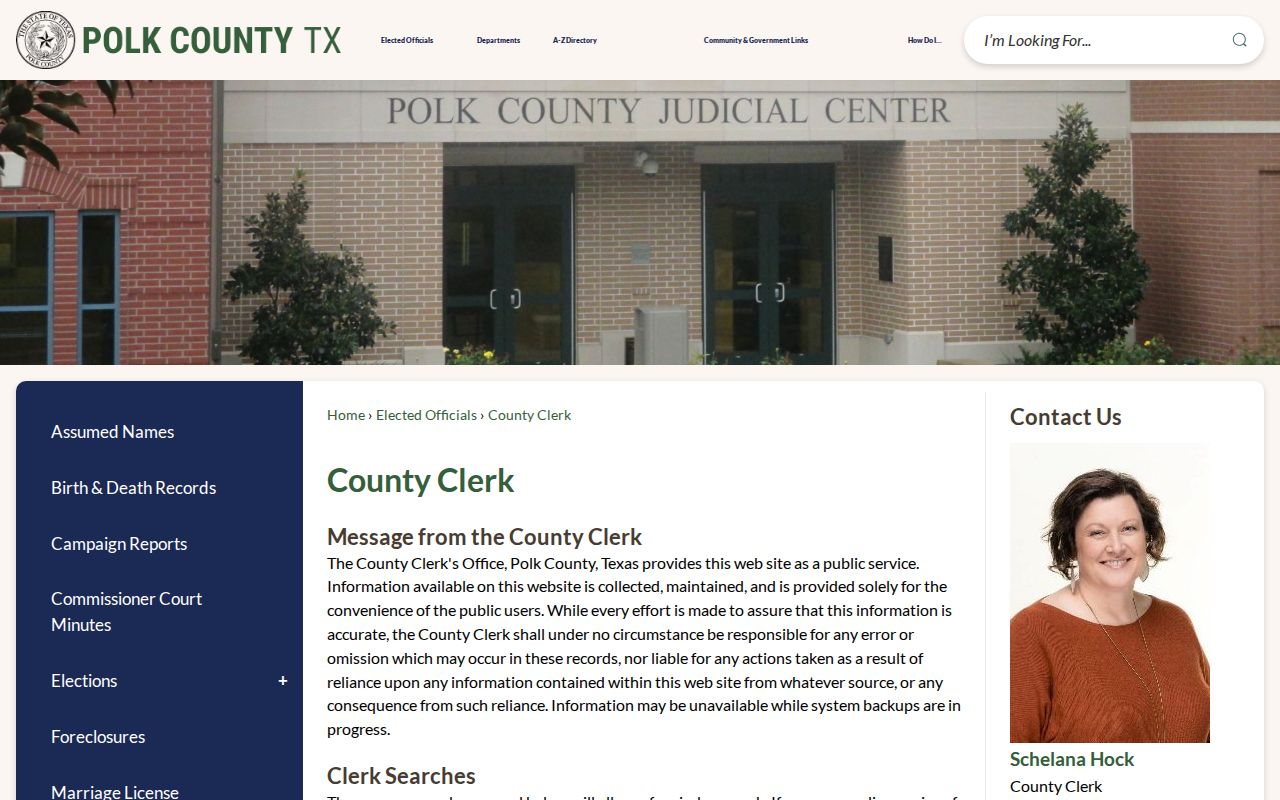
The online tools supplement the records counter. They do not merge district, JP, and municipal custody into one file system.
Polk County Court Record Types
A docket is a chronological register. A filing image is the actual petition, complaint, motion, order, judgment, or other accepted document. A clerk index points to a record. A certified copy adds clerk authentication. A transcript records spoken proceedings and comes through the court reporter or transcript service, not the ordinary copy desk.
- Docket sheets and event registers
- Petitions, complaints, answers, and motions
- Signed orders, judgments, and dismissals
- Probate applications, wills, and letters
- Certified copies, historical indexes, and transcripts
Historic Polk County Court Records
Polk's record trail reaches back to 1846. The District Clerk historical index lists civil and criminal minutes, Civil Cases 1 through 37, physician certificates, and a docket book from 1848 through 1871. Search controls include book type, year, parties, surname, given name, or book, volume, and page.
The Texas State Library Polk guide describes related archival series, including civil case papers, civil dockets, and Commissioners Court dockets. A catalog entry is not always a scan. Use it to identify the series, then ask the District Clerk whether the volume or case paper is available and how a copy may be ordered.
Inside a Polk County Court Record
The docket connects the pieces of a case through dates and event labels. It may show that a document was filed while the actual scan remains restricted or fee-based. Read the record in sequence, then compare any requested document with the cause number, court, and filing stamp.
| Cause number and style | The identifier and caption used to match the file. |
|---|---|
| Case type and court | The category and office that keeps the record. |
| Filings | Pleadings, motions, notices, and returns accepted by the clerk. |
| Settings and orders | Scheduled events and later rulings, which must not be confused. |
| Disposition | Judgment, dismissal, sentence, or another final event. |
| Access flag | Image, fee, account, redaction, or restriction status. |
Polk County E-Filed Attachments
The county's e-file instructions explain why a search may not list each exhibit separately. Motions and orders should be lead documents, while exhibits and attachments are scanned behind that lead document. Hearing exhibits should be brought to court instead of submitted through ordinary e-filing. An online register can show one lead filing even when several pages sit behind it.
Texas eFileTexas is a filing path, not a full public court-record search. Acceptance and later public indexing are distinct steps. When a known attachment cannot be found, request the lead document by title and date, then ask whether the exhibits are included and public.
Fees and Certified Copies
A regular copy serves reading and personal files. A certified copy bears clerk authentication and should be ordered when a receiving court or agency requires it. Certification does not make a request faster. County Clerk forms publish these amounts, but confirm current totals before payment.
| Item | Amount |
|---|---|
| Regular County Clerk copy | $1 per page |
| Certified County Clerk copy | $5 certification plus $1 per page |
| Letters of Testamentary | $2 each |
| Clerk search | $5 per search |
| Fax or email research copy | Separate $2 fee listed; confirm total |
Polk County District Clerk
101 W Mill Street, Suite 216
Livingston, TX 77351
936-327-6814
Polk County Transcript Requests
A hearing transcript is not a docket printout. The 258th District Court directs transcript requests to Verbatim Services. Availability, format, certification, and price belong with the reporter or service. The docket helps identify the hearing date, judge, and case, but it cannot recreate the spoken record.
Give the provider the cause number, court, hearing date, proceeding type, and format needed. For another court, ask its coordinator who served as reporter. Keep that request separate from a County Clerk document order.
Sealed Records and Public Access
Texas court access does not always follow the ordinary agency process under the Texas Public Information Act. Government Code section 552.0035 points judiciary access to Supreme Court rules and other law. Polk's custodian should identify the right process for a specific file.
Key Rules:
Texas Judicial Branch Rule 12 supplies a judicial-record framework and exceptions.
Family Code Chapter 58 protects juvenile information.
Code of Criminal Procedure Chapter 55A governs expunction limits.
Check Polk County Copies
Before relying on a delivered record, compare its cause number, court, caption, filing stamp, page count, and document title with the request. A certified copy should carry the clerk's authentication. A plain copy should not be described as certified.
If pages or exhibits appear missing, ask whether they sit behind a lead document, remain restricted, or were never filed through the ordinary electronic path. This quality check separates an incomplete download from the official file held by the custodian.
Polk County Request Details
The County Clerk's separate forms show why the record type matters. A civil requester can name a petition, judgment, or other item. A criminal request can seek information, a complaint, a judgment or dismissal, or another stated document. A probate request can identify an application, will, order, or letters. Each route asks for the party or estate name, copy type, delivery choice, contact details, and comments that narrow the search.
Use comments to give the cause number, approximate year, court, and exact instrument. “Entire file” can produce a larger search, more pages, and a different total than one named order. The County Clerk states that a clerk search costs $5 and a request may take up to ten days under the response language on its page. That timing is not a promise for every judicial record or every other Polk office.
Phone contact helps resolve a vague index entry before a payment is made. Mail works when the clerk's form permits it. An in-person counter visit may be best for an older book reference, but call first to confirm hours, location, payment method, and whether the volume is available. These channels all lead back to the same goal: a record matched to the right court and cause number.